

Brian Kennett
Amateur Chef and Boozy Traveling Foodie Extraordinaire
Musashi Japan: exceptional Japanese knives, and now including 10% discount off all purchases from your BFF's at Islifearecipe
Musashi Japan Knives: Table of Conents
Musashi Japan Chef Knives: When Your Kitchen Demands Samurai-Level Precision (And You’re Ready to Stop Hacking at Tomatoes)
Oh, my Lordy! What an absolute revelation it’s been spending the last few hours exploring Musashi Japan and their collection of Japanese chef knives, and let me tell you—once you’ve experienced the sheer joy of slicing through a tomato with a properly forged Damascus blade, going back to your old supermarket sh!t knife feels like trying to cut meat with a butter knife borrowed from a kid’s tea party.
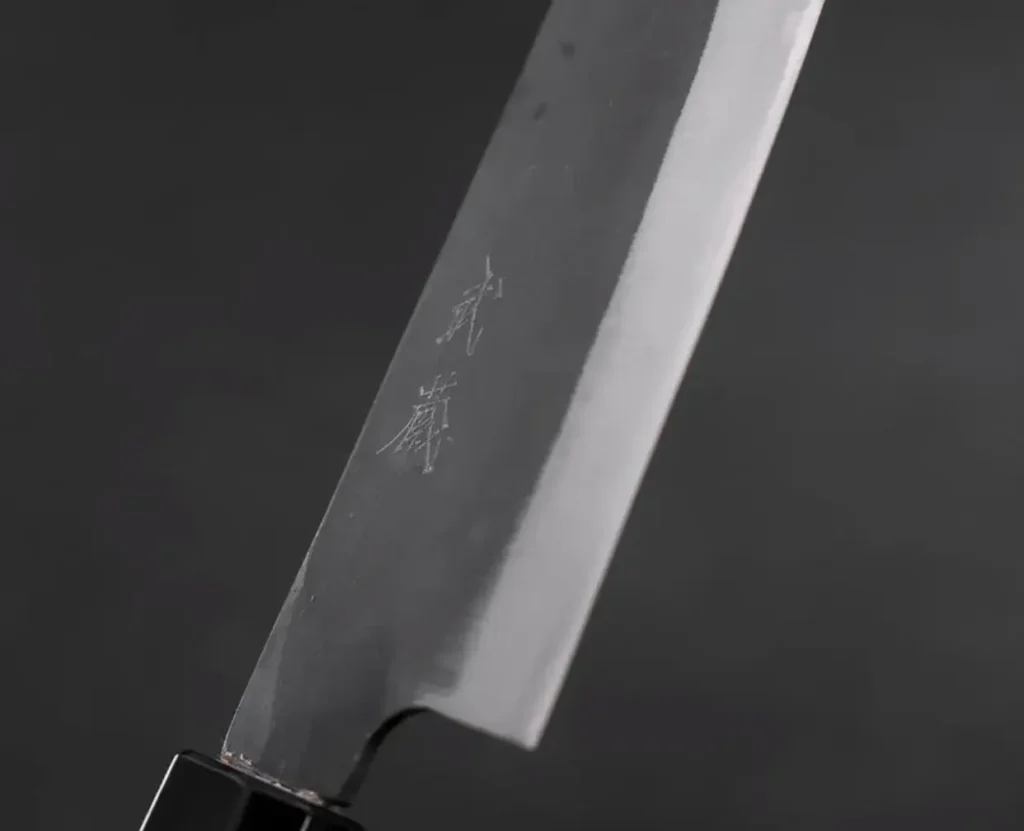
I just bought this bad boy for myself and yes indeed did enjoy the Islifearecipe 10% discount HERE. This is the rather delicious 165mm Santoku Blue Steel #1 Stainless Clad with Kurouchi Buffalo Magnolia Handle. Retail price was $314.00, and after the Islifearecipe 10% dicount it was $282.60, including shipping from Japan.
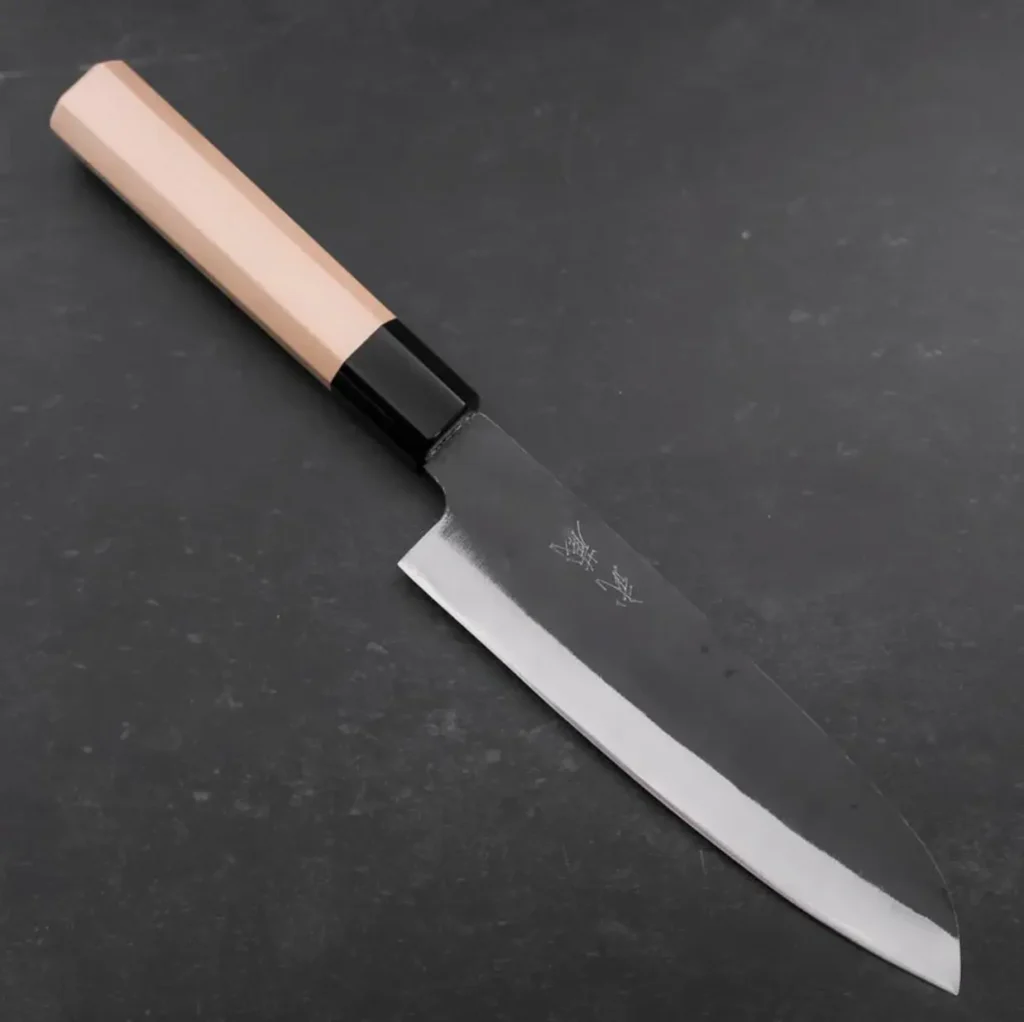
Is it wrong to get an erection over a knife?
The Musashi Hamono Story: Bridging Tradition and Your Kitchen Counter
Right, let’s address the elephant in the room—or rather, the samurai in the kitchen. Musashi Japan isn’t your gran’s old kitchen knife brands (unless your gran happened to be a Japanese bladesmith with impeccable taste). These folks position themselves as a bridge between Japanese traditional craftsmanship and modern kitchen living, which sounds lovely on paper but can sometimes mean “we’ve slapped a fancy animal horn handle on mediocre steel and called it artisanal.”
Thankfully, that’s absolutely not the case here. Musashi works directly with Japanese artisans to create knives that actually honour centuries-old bladesmithing techniques whilst acknowledging that most of us aren’t preparing kaiseki cuisine in our home kitchens. We need knives that perform brilliantly without requiring a PhD in metallurgy.
What particularly impressed me about the Musashi Japan philosophy is their commitment to education. Their website doesn’t just flog knives at you—it actually teaches you about steel types, best knife types for certain use cases, handle materials, and maintenance techniques. There’s a proper knife guide that helps you choose between carbon steel and stainless steel based on your actual cooking habits, not some romanticized notion of what kind of cook you’d like to be. (Spoiler alert: if you occasionally forget to dry your knives immediately after washing, stainless steel should be your best friend.)
Special Offer for Is Life a Recipe Readers - 10% DISCOUNT
Right, here’s the bit you’ve been waiting for—my readers get an exclusive 10% discount on all Musashi Japa knife purchases. Just click the link above and get on with your browsing, the 10% discount gets applied at checkout. That’s $31 SGD off their popular VG-10 Gyuto, or nearly $78 SGD off those gorgeous Chokin series pieces with hand-engraved designs.
Ten percent on premium Japanese chef knives, is a substantial saving that could cover you for a quality whetstone, cutting board, or protective saya (blade cover). Every bit helps when investing in tools that’ll outlast most of your other kitchen appliances.
Steel Types Decoded: VG-10, Silver Steel, and Other Mysteries
Let’s talk steel, because this is where things get properly interesting. Musashi Japan offers several different steel options across their range, and understanding the differences matters if you’re investing serious money in Japanese chef knives.
VG-10 Stainless Steel is Musashi’s workhorse material, and it’s brilliant for home cooks. It’s a cobalt alloy stainless steel from Takefu Special Steel that offers strong corrosion resistance whilst maintaining excellent edge retention. Translation: it stays sharp for ages and won’t rust if you accidentally leave it in the sink overnight. (Not that my Wifey has ever done such a thing. Ahem.) The VG-10 Damascus knives feature that gorgeous wavy pattern created by layering multiple types of steel—it’s functional art that happens to slice garlic beautifully.
Silver Steel #3 is where things get serious. This is a high-carbon steel that takes an absolutely wicked edge and holds it brilliantly, but it requires more attention to maintenance. You’ll need to dry it immediately after use and oil it occasionally to prevent rust. The performance payoff is substantial—I’ve never experienced such effortless cutting in my life. It’s like the knife knows what you’re trying to do before your brain sends the signal to your hand.
White Steel #2 and Blue Steel #2 are traditional Japanese carbon steels for absolute knife enthusiasts. These develop a patina over time (a darkening of the blade that actually protects against rust) and offer exceptional sharpness. They’re high-maintenance beauties that reward your attention with performance that borders on magical. This is what I just made my latest investment in, and I can’t wait to get that bad boy in my hands…
The diversity of steel options at Musashi Japan means there’s genuinely something for every skill level and maintenance tolerance. Starting with stainless steel makes perfect sense for most home cooks, with the option to graduate to carbon steel as your confidence and care routines improve.
The Damascus Pattern: Function or Fancy?
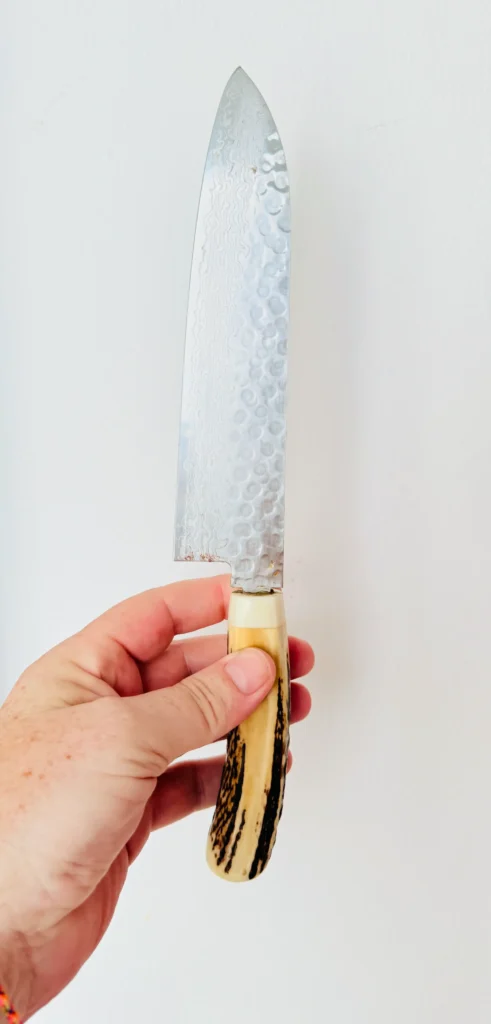
This is another of my very own Musashi Japan Knives – deer antler handle with Damascus steel blade: WOOF!!!
I’ll be honest—when I first saw Damascus pattern knives, I thought it was purely aesthetic wankery (am I allowed to say that?). Pretty wavy lines that add $2-300 to the price whilst doing absolutely nothing for performance. Turns out I was partially wrong, which happens approximately never, so pay attention.
The Damascus pattern on Musashi Japan knives results from layering different types of steel during the forging process. This layering actually serves several purposes beyond looking absolutely gorgeous on my magnetic knife strip, as you’ll see below. The multiple layers create micro-serrations along the blade edge, which help reduce friction and prevent food from sticking. Ever tried slicing cucumber with a knife that creates perfect vacuum-seal suction with every cut? Infuriating. Damascus patterns help prevent that.
Additionally, the layering process creates a blade with varied hardness throughout, combining the best properties of different steels. The VG-10 core provides that sharp, durable edge, whilst the softer outer layers offer flexibility and shock absorption. It’s engineering that happens to be beautiful, which is my favourite kind of engineering.
The aesthetic appeal shouldn’t be dismissed entirely, mind you. There’s genuine pleasure in using beautiful tools. Every time I pick up my knives with their flowing Damascus patterns and deer antler handle, I feel like I should be preparing something more sophisticated than cheese on toast. (I rarely am, of course, but the feeling persists.)
Handle Materials: More Than Just Something to Grip
The handles on Musashi Japan knives deserve serious appreciation because they’ve gone far beyond “a stick of wood attached to the sharp bit.” The variety of handle materials available shows real thought about different preferences and aesthetics.
Ebony handles offer that classic Japanese knife look—sleek, dark, and impossibly smooth. They develop a lovely patina over time from the oils in your hand, becoming increasingly personal to you. The weight provides excellent balance, though they may require occasional oiling to prevent drying out.
Buffalo horn and bone handles are gorgeous statement pieces, and I should know as I have one. Each one is completely unique due to natural variations in the material. They’re surprisingly practical too—naturally water-resistant and incredibly durable. I was initially skeptical about the ethics, but Musashi Japan sources these materials responsibly as byproducts from food industries.
Wenge and oak handles offer different tactile experiences. The Wenge is dense and exotic-looking with striking grain patterns, whilst oak provides a more rustic, traditional feel. Both are treated with food-safe oils to protect against moisture whilst maintaining their natural beauty.
Urushi lacquered handles are works of art. Traditional Japanese urushi lacquer is applied in multiple layers, creating a finish that’s both beautiful and incredibly durable. The purple urushi handle on their Santoku is so stunning I’ve caught myself just staring at it like some sort of knife-obsessed weirdo. Which, to be fair, I suppose I am.
The octagonal handle shape preferred by Musashi Japan provides excellent grip and prevents the knife from rolling on your cutting board. It’s one of those small details you don’t appreciate until you’ve gone back to using a traditonal round-handled knives that insist on trying to help you with committing suicide as you slice.
Knife Types: Finding Your Perfect Match
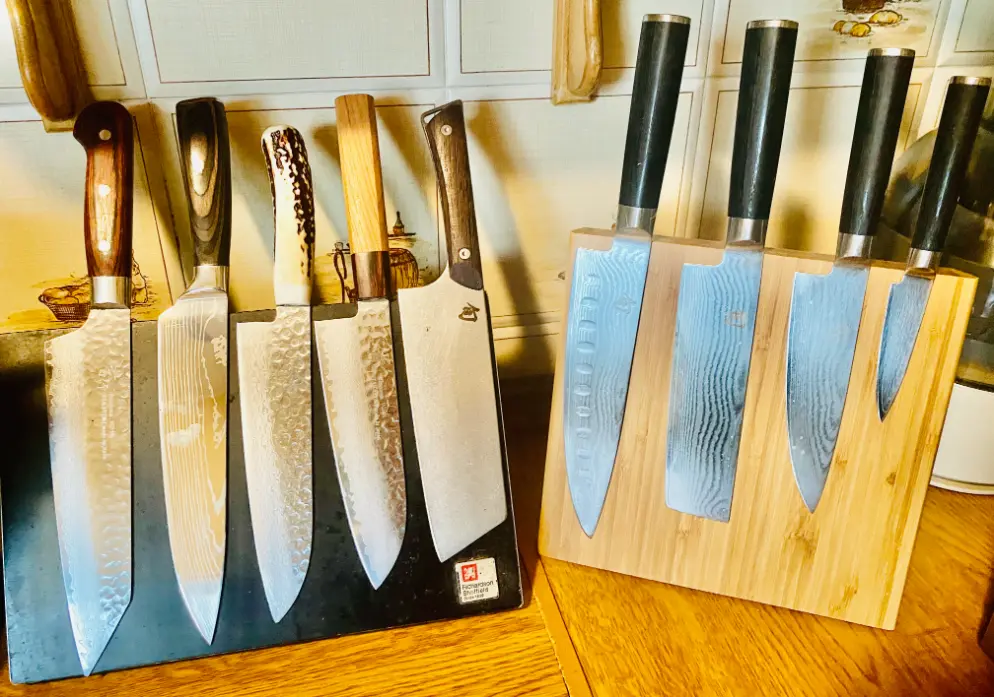
How to choose your perfect match? Can you? Or, if you’re like me, just buy the lot… yes this is some of my collection
Musashi offers an impressive range of knife styles, each with specific purposes. Let’s break down the most useful for home cooks:
Gyuto (Chef’s Knife) is your all-purpose workhorse. The 210mm version is my daily driver—long enough for serious cutting tasks but maneuverable enough for detailed work. Perfect for everything from breaking down a chicken to mincing garlic.
Santoku is the three-virtue knife (referring to meat, fish, and vegetables). Shorter than the Gyuto with a straighter edge, it’s brilliant for chopping and precise cuts. Many people find the Santoku more comfortable for rock-chopping techniques. The 165mm-180mm range is ideal for most hands and tasks.
Kiritsuke is the sexy one—a hybrid between Gyuto and Yanagiba with an angled tip that looks absolutely badass. Traditionally, only head chefs in Japanese kitchens were allowed to use Kiritsuke knives, which should tell you something about their versatility and intimidation factor. It’s my favourite for showing off and usually save it for slicing reverse-seared tomahawk steaks, though I’ll admit the Gyuto gets more daily use.
Bunka is criminally underrated. Similar to Santoku but with a reverse tanto (angled) tip that’s brilliant for detailed work. The flat belly makes it perfect for chopping, whilst the sharp tip handles precision tasks beautifully.
Petty is your small utility knife for detailed work—peeling, trimming, small vegetable prep. The 135mm-155mm size range is perfect for tasks where a large knife feels unwieldy. I love my petty, I also have a switch-blade version which I carry everywhere.
For those interested in single-purpose excellence, Musashi Japan also offers:
Yanagiba for slicing sashimi and delicate fish work Deba for breaking down whole fish Nakiri for vegetable preparation Sujihiki as a slicing knife for cooked meats. The beauty of Musashi’s range is you can start with a Gyuto or Santoku and add specialized knives as your skills and interests develop. I started with one Gyuto and now own TEN Japanese knives, each with specific jobs. My darling Wifey calls it knife hoarding. I prefer “curated collection.”
Performance Testing: Does Pretty Mean Sharp?
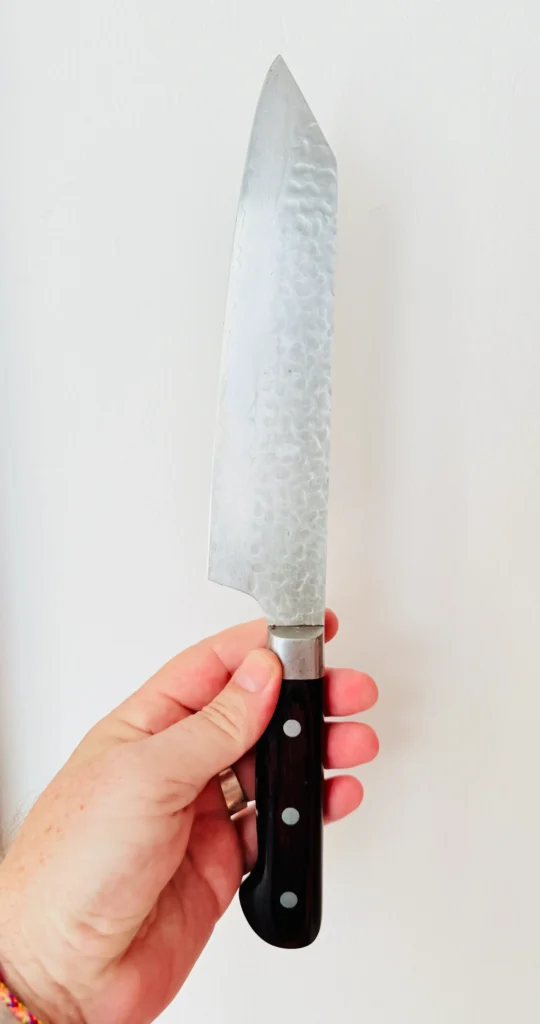
I promise you, you can never have enough Japanese knives: get on to Mushami Japan and get ordering haha
Right, let’s get to the actual cutting, because pretty knives that can’t slice are just expensive wall decorations. I’ve put my Damascus Gyuto through proper paces over the years, and the results are remarkable: with a bi-annual professional sharpening.
Paper test: try a slice through printer paper. Tomato test: The ultimate knife test, isn’t it? Try a slice through a ripe tomato with minimal pressure and see if you can get those wafer-thin slices you see in fancy restaurant photographs? Onion dicing: Here’s where sharpness really matters for reducing tears, not from the buying but from the chopping. The Musashi Japan knives cut through onion cells so cleanly there’s minimal release of the irritating compounds. Life-changing might be overstating it, but eye-comfort-changing absolutely applies.
Maintenance: Keeping Your Investment Sharp (Literally)
Japanese chef knives require more attention than your average supermarket blade, but it’s not the intimidating commitment some sources suggest. Here’s the reality:
Daily care: Wash by hand immediately after use with mild soap and warm water. Dry thoroughly. That’s it. Don’t put these knives in the dishwasher unless you hate beautiful things and want to punish them.
Weekly care (for carbon steel): Quick wipe with food-grade mineral oil to prevent rust. Takes approximately twenty seconds.
Monthly sharpening (depending on use frequency): A few passes on a whetstone keeps the edge keen. Musashi Japan provides excellent guides on their website about proper sharpening angles and techniques. I was initially intimidated by whetstones, but after watching their tutorials, I’m now irritatingly evangelical about hand-sharpening: but I have to admit, I do outsource it once a quarter to my Knife BFF, Sean, who is EPIC: +65 9154 5607: he collects and drops off. Totally awesome service for the more ‘lazy-by-nature’.
Storage: Magnetic knife strips are brilliant for Japanese knives, and that’s what I have—they display them beautifully whilst protecting the edges. Knife blocks can work if they don’t require forcing the blade in (which damages edges). Never just chuck them in a drawer with other utensils like some sort of kitchen barbarian.
The Collections: Samurai Series and Beyond
Musashi organizes their knives into “Samurai Collections” (North, South, East, West, Central), which initially struck me as marketing gimmickry. However, it’s actually a clever way to navigate their extensive range based on steel types, handle materials, and aesthetics.
The Chokin Series deserves special mention—these are absolute works of art featuring hand-engraved designs on the blade. Sakura blossoms, waves, butterflies, and clouds are meticulously carved into the steel by skilled craftsmen. These pieces blur the line between kitchen tool and art object. At $520-$770, they’re investments, but they’re genuinely unique and would become family heirlooms.
For those starting their Japanese knife exploration, I’d recommend the VG-10 Damascus series. The Gyuto at $307 or Santoku at $376 offer exceptional value for hand-forged Japanese knives with proper Damascus layering and quality handles. They perform brilliantly whilst being relatively forgiving about maintenance: kind of like Singapore being the Asia for beginners…
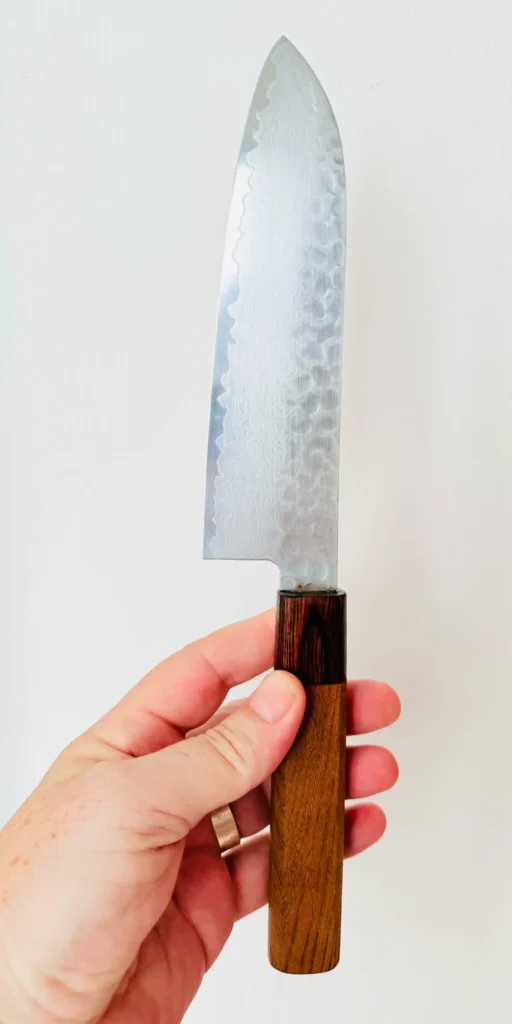
My ultimate and all-time favourite Chef knife – I am in love with this knife
Price Point Analysis: Worth the Investment?
Let’s address the obvious—these aren’t cheap knives. Musashi Japan has a range that spans from around $307 to over $858 for specialized pieces. That’s serious money for something that ultimately just cuts things.
Here’s my perspective after using both budget and premium knives: the difference in daily cooking enjoyment is substantial. A proper Japanese chef knife transforms food preparation from chore to pleasure. Vegetables slice cleanly rather than being crushed. Meat portions cleanly instead of tearing. The difference in your cooking results—texture, presentation, even flavour (crushed herbs release bitter compounds versus cleanly cut)—justifies the investment for anyone who cooks regularly.
Consider that a decent Western chef’s knife from established brands costs $300-400. For home cooks cooking 4-5 times weekly, a Musashi Gyuto or Santoku will likely last decades with proper care. That’s potentially thousands of meals over the knife’s lifetime. Amortized cost per meal becomes negligible whilst the enjoyment factor increases significantly.
The Verdict: Should You Samurai Up Your Kitchen?

I seriously can’t help myself, there must be some Samurai in me from somewhere – you cannot beat Musashi Japan knives…
After years with Japanese knives, I’m thoroughly converted and these wil be all I will ever buy now – literally, nothing compares. These aren’t just sharp implements—they’re genuine expressions of centuries-old Japanese bladesmithing adapted for modern kitchens.
Who should buy Musashi Japan knives:
- Home cooks ready to invest in quality tools,
- Anyone frustrated with constantly dull blades,
- Food enthusiasts who appreciate craftmanship,
- People willing to learn basic knife maintenance,
- Those who find joy in using beautiful, functional objects.
Who might want to wait:
- Absolute beginners still learning knife skills,
- Anyone unwilling to hand-wash and care for knives properly,
- Cooks who primarily use pre-cut ingredients,
- Those on very tight budgets (perfectly fair—save up-have a birthday).
The Musashi Japan website offers proper educational resources, clear photography, and honest information about their products. Their range covers enough variety that most cooks can find something suitable, from beginner-friendly stainless steel to advanced carbon steel options.
Special Offer for Is Life a Recipe Readers - 10% DISCOUNT
I am now repeating myself, but it is important, because, here’s the bit you’ve been waiting for—you guys get an exclusive 10% discount on all Musashi Hamono purchases. Just use the link above, and at checkout you will automatically be allocayed your savings.
Final Thoughts: The Joy of Sharp Tools
There’s something deeply satisfying about using properly sharp, well-balanced tools. It’s not pretension or food snobbery—it’s simple appreciation for objects that perform their intended function brilliantly. Musashi Japan delivers that experience through knives that honour traditional Japanese craftmanship whilst acknowledging the realities of modern home cooking.
My tomatoes now fear me. My onions weep less (both metaphorically and literally). My chicken breasts portion cleanly instead of looking like they’ve been attacked by a angry badger. And every time I reach for my Gyuto with its flowing Damascus pattern and perfectly balanced handle, I feel a small thrill of anticipation for whatever cooking adventure awaits. I kid you not!!!
Is that dramatic? Perhaps. But after decades of struggling with mediocre knives, I’m allowed a bit of knife-induced euphoria. These Japanese chef knives have genuinely improved my cooking experience, and I suspect they’ll do the same for you.
Now if you’ll excuse me, I have some vegetables to intimidate with my superior cutting implements. They never saw me coming. ENJOY!!!